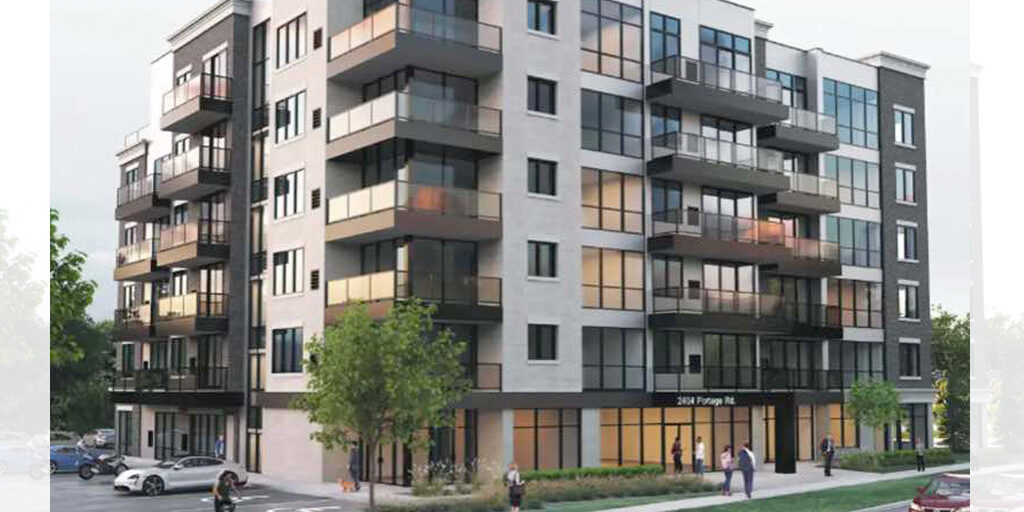
Scrolling through the news in 2026 feels unsettling for any homebuyer. Iran–U.S. tensions are generating sanctions, official Canadian statements, and real ripple effects well beyond the Middle East. Meanwhile, Canada’s housing agencies are openly citing geopolitical and trade uncertainty as a reason buyer demand remains cautious this year. See the latest statements from Global Affairs Canada and the Bank of Canada.
For Toronto buyers, the real question is not whether the headlines are dramatic. The question is: should they change a property decision worth hundreds of thousands of dollars?
| The honest answer is yes — but indirectly. Global tension does not crash Toronto real estate. What it does is reshape the economic forces that matter most to buyers: inflation, borrowing costs, construction activity, and confidence. And when those forces shift, the balance between condos and houses shifts with them. |
Where Toronto Stands Right Now
The Toronto market is not in panic. It is in a price-sensitive, negotiation-friendly, confidence-dependent phase.
TRREB (Toronto Regional Real Estate Board) reported 3,868 GTA home sales in February 2026, down 6.3% from February 2025. The average selling price was $1,008,968 — down 7.1% year over year. Elevated inventory across most segments is expected to keep a lid on price growth, with TRREB forecasting the GTA average in a $1.0M–$1.03M range for 2026.
CMHC (Canada Mortgage and Housing Corporation)’s national outlook adds further context: housing demand is expected to improve gradually, but sales should stay below historical averages. Ontario is the only region projected to see price declines in 2026. New condo construction is especially weak, because pre-construction sales collapsed in 2025. For rental market data and affordability tools, also see CMHC Housing Market Information Portal.
That is the environment buyers are operating in. Not a crash. Not a boom. A selective market — and in a selective market, property type matters more than headlines.
How Geopolitical Stress Hits Condos and Houses Differently
Geopolitical conflict only matters to Toronto real estate when it changes one of five local variables: mortgage affordability, inflation and rates, construction costs, future supply, or buyer confidence. Right now, it is moving several of them at once.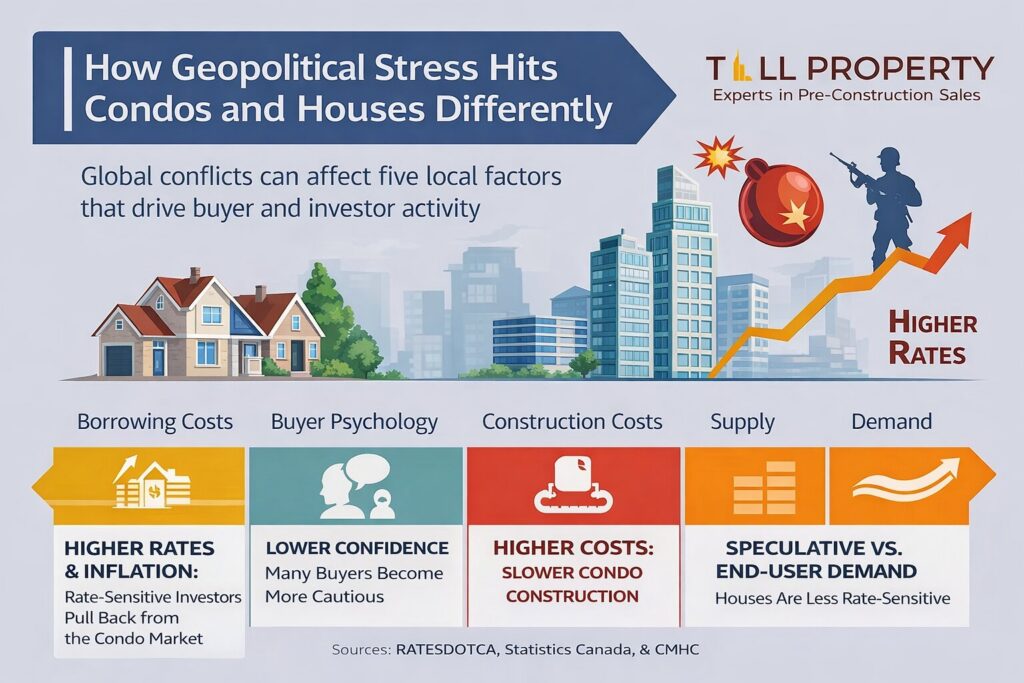
1. Inflation and Borrowing Costs
Middle East instability can push energy prices higher, which keeps inflation stickier for longer. The Bank of Canada held its policy rate at 2.25% on January 28, 2026, with policymakers flagging ongoing tariff and trade uncertainty as reasons for caution. Track live rate decisions at the Bank of Canada Policy Rate page. For mortgage rate comparisons, see RATESDOTCA and RateHub.ca.
If geopolitical risk keeps inflation elevated, mortgage relief may arrive more slowly than buyers hoped. That matters most in the condo market, where investors are more rate-sensitive than freehold end-users.
2. Buyer Psychology and Confidence
Real estate is not purely mathematical. When buyers see major international tension, many become more cautious — delaying offers, questioning timing, reassessing job security. In softer markets, that hesitation reduces demand further. In family-oriented segments, it may delay transactions rather than eliminate them. Monitor sentiment trends via Statistics Canada Consumer Confidence.
3. Construction Costs and Future Supply
CMHC has flagged that developers still face high construction costs and weakening demand, particularly in the condo segment. Toronto condo starts are especially soft. Weak near-term condo demand can pressure prices now, but reduced future construction will eventually tighten supply once demand recovers. Track housing starts data at CMHC Housing Starts.
4. Speculative vs. End-User Demand
Geopolitical uncertainty hits speculative housing first. Investors pull back faster than end-users do. A family buying a home because life demands it may still act. A buyer chasing short-term appreciation will often wait out the headlines. Since condos attract disproportionately more investor demand while freehold homes serve more durable household needs, this distinction is especially important in 2026.
The Case for Buying a Condo in 2026
There is a real argument for condos this year — especially for first-time buyers.
What makes condos attractive
Condos remain the most accessible entry point into Toronto real estate. A softer segment gives buyers more negotiating power and more inventory to choose from. A well-located condo near transit, employment, or major infrastructure can still outperform a mediocre freehold in a weak location. For first-time buyer incentives and down payment programs, visit Canada Housing Benefits – CMHC and the First Home Savings Account (FHSA) – CRA.
Top Toronto condo builders to research
These are among Canada’s most active and established condo developers in the GTA:
- Concord Adex — large-scale master-planned communities
- Menkes Developments — high-rise condos and mixed-use projects across Toronto
- Tridel — one of Canada’s largest condo builders, strong sustainability record
- Mattamy Homes — Canada’s largest privately owned builder, condos and low-rise
- The Daniels Corporation — award-winning mixed-income and mixed-use communities
- Great Gulf — high-rise condos and master-planned developments in the GTA
Where condo buyers must be disciplined
A condo in 2026 is not automatically a bargain. Some units are cheap for a reason. The risks to avoid:
- High maintenance fees that erode monthly affordability
- Weak reserve funds in aging buildings
- Investor-heavy buildings with soft rental economics
- Small or inefficient layouts with limited resale appeal
- Too much competing inventory in the same corridor
In nervous markets, buyers become far more selective. A great condo in a strong building can still perform well. An average condo can sit for months. Review condo corporation documents and status certificates carefully. Ontario’s condo regulator is the Condominium Authority of Ontario (CAO).
Who should buy a condo now
A condo makes sense in 2026 if you are a first-time buyer who needs an affordable entry point, plan to live in the unit as an end-user, and are buying a quality building in a strong location with the intention of holding for at least five years. The best condo strategy is not “buy any condo because prices are softer.” It is: buy only the right condo, in the right building, at the right number.
The Case for Buying a House in 2026
When people feel uncertain, they place more value on stability, control, and long-term utility. That is exactly why freehold housing tends to look stronger during periods of economic and geopolitical stress.
What houses offer that condos do not
A house gives you land, flexibility, and scarcity. Even in a cooler market, well-located freehold housing in and around Toronto benefits from structural supply constraints. The buyer pool for good houses is more durable — driven by family formation, school district preferences, work-from-home space needs, rental suite flexibility, and multi-generational living requirements.
CMHC’s 2026 outlook reinforces this: Ontario housing starts are expected to fall, and condo starts are particularly weak. Supply challenges are not disappearing just because demand is softer this year. See Ontario-specific housing data at CMHC Ontario Housing Outlook.
Top freehold and low-rise builders in Canada / GTA
These builders specialize in freehold homes, townhomes, and low-rise communities in and around the GTA:
- Mattamy Homes — Canada’s largest privately owned homebuilder
- Tribute Communities — master-planned communities across southern Ontario
- Greenpark Homes — over 50 years building in the GTA
- Lindvest Properties — freehold and condo communities in the GTA
- Branthaven Homes — low-rise and townhome communities across the Greater Golden Horseshoe
- CountryWide Homes — affordable freehold townhomes in the GTA
The inflation hedge argument
When uncertainty keeps replacement costs and land scarcity in focus, freehold housing tends to look more defensible than high-density product with rising monthly fees. CMHC’s own warnings that developers still face high costs means new supply will remain constrained even as demand eventually returns. For construction cost benchmarks, see Statistics Canada Building Permits.
The real risks of buying a house now
The biggest risk is payment shock. Even in a softer market, a detached or semi-detached Toronto home demands far more monthly carrying power than a condo. Stretching into a house purely because it “feels safer” can become a financial trap. Use the CMHC Mortgage Calculator and OSFI mortgage stress test rules to pressure-test your numbers before committing.
Condo or House: The Clearest Answer
| If the question is which asset looks stronger in a world of geopolitical stress, the answer is generally the house. If the question is which purchase is smarter for the average Toronto buyer in 2026, the answer depends on your budget and stage of life. |
Condos win on affordability and market entry. Houses win on resilience, land value, and long-term family utility. The right decision is not driven by fear of geopolitical headlines. It is driven by whether those headlines reinforce the economic reality you are already facing: higher sensitivity to rates, more caution around speculative assets, and more value placed on durable housing choices.
 Buy a condo if:
- You need a lower purchase price to enter the Toronto market
- You plan to live in the unit as an end-user for at least five years
- You can identify a quality building in a strong location — not just a low price
- Your alternative is waiting indefinitely while rents and life plans keep moving
Buy a house if:
- Your budget can comfortably carry the mortgage, taxes, maintenance, and rate volatility
- You plan to stay put for several years and want long-term family utility
- You value land, flexibility, and supply scarcity over short-term affordability
- You want resilience against the kind of economic uncertainty 2026 is producing
What Buyers Should Do Right Now
Rather than reacting emotionally to headlines, Toronto buyers in 2026 should anchor their decisions to five practical principles:
-
Focus on payment, not just purchase price
A cheaper condo with high fees can become less affordable than expected. Model the full monthly cost before committing. Use the CMHC Mortgage Qualifier Tool and speak with a licensed mortgage broker. Find brokers via Mortgage Professionals Canada.
-
Treat 2026 as a selective market
TRREB and CMHC both describe a market that is softer than normal, more balanced for buyers, and still sensitive to weak confidence. Selectivity is your edge — use it. Review monthly market stats at TRREB Market Stats and CMHC Housing Market Reports.
-
Be more rigorous with condos than with houses
Building quality matters enormously in this environment. Check the reserve fund, the fee trajectory, the investor-to-owner ratio, and the rental economics before you make an offer. Ontario status certificate guidance is available from the Condominium Authority of Ontario.
-
Do not buy a house for status alone
Buy it only if the budget is genuinely strong enough to absorb repairs, taxes, utilities, and rate movement without financial stress. Review land transfer tax costs via Ontario Land Transfer Tax Calculator and City of Toronto Land Transfer Tax.
-
Think in years, not weeks
Geopolitical headlines move sentiment fast. Real estate wealth is built more slowly, through good property selection and patient holding periods. Clarity beats panic. Property selection beats headlines. For long-term market context, explore CMHC Historical Housing Data and Statistics Canada Real Estate Statistics.
Key Government & Official Resources
Bookmark these authoritative sources for ongoing research throughout your buying journey:
Federal Government
- Canada Mortgage and Housing Corporation (CMHC) — housing data, outlooks, buyer tools
- Bank of Canada – Monetary Policy — rate decisions and economic outlook
- Canada Revenue Agency – Home Buyers’ Plan — RRSP withdrawal for first-time buyers
- First Home Savings Account (FHSA) — tax-free savings for first home
- Global Affairs Canada – Iran Sanctions — official Canadian sanctions policy
- OSFI – Mortgage Stress Test Rules — qualifying rate regulations
Ontario & Toronto
- Ontario Ministry of Municipal Affairs and Housing — provincial housing policy and programs
- City of Toronto – Housing — local programs and buyer resources
- Ontario Land Transfer Tax — tax rates and first-time buyer rebate
- Condominium Authority of Ontario (CAO) — condo corporation search and buyer guidance
- TRREB Market Statistics — monthly GTA sales and price data
- Financial Services Regulatory Authority of Ontario (FSRA) — licensed mortgage broker verification
Final Conclusion
Iran–U.S. tensions matter to Toronto real estate in 2026 — not because they directly determine local prices, but because they can influence inflation, rates, confidence, and construction conditions. Those forces shape the decision between condos and houses in ways that are real and measurable.
The smartest Toronto buyers in 2026 are not asking, “Will this headline crash the market?” They are asking, “Which property type gives me the best balance of affordability, stability, and long-term upside in a more uncertain world?”
| For some, that answer will be a carefully chosen condo. For many serious end-users with stronger budgets, that answer will be a house. Either way, the decision should be grounded in numbers and needs — not noise. |