
Why Tariffs Matter for the Ontario Housing Market
Global trade policies can influence far more than international commerce. In recent years, tariffs between the United States and Canada have had ripple effects across multiple industries, including construction, infrastructure, and real estate.
When tariffs increase the cost of construction materials such as steel, aluminum, lumber, and industrial components, developers face higher building costs. These increases can ultimately influence the prices of homes, condos, and rental properties across Ontario.
This article explores how United States–Canada tariff policies could influence housing prices across Ontario and how buyers should evaluate condo vs house decisions during global economic uncertainty.
Understanding United States–Canada Tariff Policies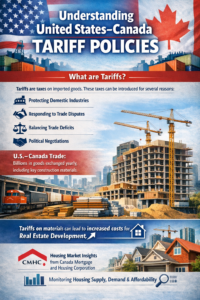
Tariffs are taxes imposed by governments on imported goods. These taxes can be introduced for several reasons:
-
Protecting domestic industries
-
Responding to trade disputes
-
Balancing trade deficits
-
Political negotiations
Trade relations between the United States and Canada are among the largest in the world. The two countries exchange billions of dollars in goods every year, including materials used in construction and infrastructure.
When tariffs increase the cost of materials moving between the two countries, industries that rely on these materials—such as real estate development—may experience rising costs.
Housing market reports and construction statistics are frequently published by the Canada Mortgage and Housing Corporation, which monitors housing supply, demand, and affordability trends across Canada.
Why Ontario Real Estate Is Highly Sensitive to Trade Policies
 The
However, Ontario’s housing market also faces several structural challenges:
-
Limited housing supply
-
Rising construction costs
-
High land prices
-
Rapid population growth
When tariffs increase the cost of imported construction materials, these challenges can become even more significant.
Tariffs and Rising Construction Costs
Construction projects depend on multiple international supply chains. Many key materials are traded across borders.
Examples of tariff-sensitive materials include:
-
Steel structures used in high-rise buildings
-
Aluminum framing systems
-
Electrical and HVAC equipment
-
Industrial glass panels
-
Construction machinery
When tariffs increase prices on these materials, developers must adjust their project budgets.
This often results in:
-
Higher home prices
-
Higher condo prices
-
Delayed development projects
-
Reduced housing supply
Government housing policies and development regulations can be reviewed through the Ontario Ministry of Municipal Affairs and Housing.
Impact on Toronto Condo Developments
Toronto has one of the largest condominium markets in North America.
Dozens of new condo towers are built every year to meet housing demand from both residents and investors.
Major developers such as Tridel play a major role in shaping Toronto’s skyline.
Tariffs that increase construction costs can influence the price of pre-construction condos. Developers may increase unit prices to maintain project profitability.
As a result, buyers exploring Toronto condos for sale or pre-construction condo investments may notice rising prices during periods of trade tension.
Impact on Detached Homes and Suburban Housing
Tariffs also affect suburban housing developments.
Detached homes require large quantities of materials such as lumber, concrete, steel, and roofing components. Rising material prices can increase the cost of building new homes.
Large builders such as Mattamy Homes develop many residential communities across Ontario.
When construction costs rise, developers may raise home prices or slow down new housing projects.
For buyers searching for resale homes in Toronto or Mississauga, this can reduce housing supply and push prices higher.
Why Mississauga Real Estate Is Closely Connected to Toronto
The city of Mississauga has become one of the fastest-growing real estate markets in the Greater Toronto Area.
Many buyers who find Toronto housing prices too expensive choose Mississauga as an alternative.
Mississauga offers several advantages:
-
Strong job market
-
Modern condo developments
-
Lower housing prices compared to downtown Toronto
-
Access to major highways and transit networks
However, tariff-driven construction cost increases affect developers across the entire Greater Toronto Area.
This means housing prices in both Toronto and Mississauga may rise when construction costs increase.
Condo vs House: What Should Buyers Choose During Economic Uncertainty?
For many buyers, the biggest decision is whether to purchase a condominium or a detached house.
Trade tensions and global economic uncertainty can influence this decision.
Understanding the strengths of each property type can help buyers choose the right investment.
Advantages of Buying a Condo
Condos are often the most accessible entry point into the Ontario housing market.
Lower Purchase Price
Condos generally cost less than detached homes in Toronto and Mississauga.
This makes them attractive to:
-
First-time buyers
-
Young professionals
-
Real estate investors
Strong Rental Demand
Toronto has one of the strongest rental markets in Canada.
Population growth and immigration create continuous demand for rental housing.
Many investors purchase condos specifically to rent them out.
Urban Locations
Condos are usually located near:
-
Public transit
-
Business districts
-
Universities
-
Entertainment areas
These locations increase rental demand and long-term property value.
Advantages of Buying a Detached House
Detached homes offer a different set of benefits.
Land Ownership
Owning land can significantly increase property value over time.
Land scarcity in cities like Toronto makes detached homes attractive long-term investments.
Larger Living Space
Detached homes provide more space for families and long-term living.
Potential Long-Term Appreciation
Historically, detached houses in major cities tend to appreciate strongly due to limited supply.
Rental Investment Opportunities in Ontario
Tariffs and economic uncertainty can influence housing demand patterns.
When housing prices increase, many people delay buying homes and choose to rent instead.
This increases demand for rental properties.
Investors often benefit from:
-
High rental demand
-
Strong occupancy rates
-
Long-term property appreciation
Rental investments can include:
-
Condo units
-
Duplex homes
-
Multi-family properties
-
Purpose-built rental buildings
How Global Geopolitics Can Influence Housing Markets
Global conflicts and geopolitical tensions can influence housing markets in several ways.
These include:
-
Energy price increases
-
Supply chain disruptions
-
Inflation in construction materials
-
Investor uncertainty
For example, international conflicts can disrupt global trade routes and increase commodity prices.
These cost increases can ultimately affect housing prices in cities like Toronto.
Long-Term Outlook for Ontario Real Estate
Despite global trade tensions, Ontario remains one of the strongest real estate markets in North America.
Several long-term factors support housing demand:
-
Immigration growth
-
Strong economy
-
Limited housing supply
-
Expanding infrastructure
-
High rental demand
These factors suggest that property prices in Toronto and surrounding cities may continue to grow over the long term.
Conclusion
Tariff policies between the United States and Canada may appear to be distant economic issues, but they can have significant effects on the housing market in Ontario.
Rising construction costs, supply shortages, and development delays can influence property prices across cities like Toronto and Mississauga.
For buyers and investors, understanding how global trade policies affect housing markets can help guide better real estate decisions.
Whether purchasing a condo, resale home, or rental investment property, staying informed about economic trends and tariff policies can provide valuable insights when navigating the Ontario real estate market.